
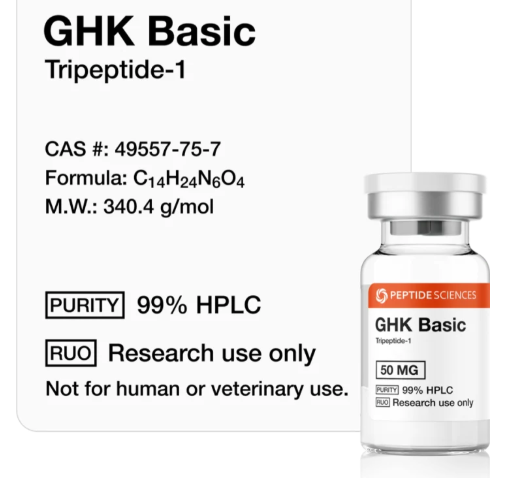
GHK, also referred to as Tripeptide-1, is a naturally occurring tripeptide with the amino acid sequence glycyl-histidyl-lysine. It has been detected in human plasma and other biofluids and is studied as a copper-binding peptide capable of interacting with multiple molecular pathways. In laboratory research, GHK is commonly evaluated for its association with transcriptional regulation across gene networks involved in tissue remodeling, protein turnover, oxidative balance, and inflammatory signaling.
When complexed with copper (GHK-Cu), the peptide forms a coordination complex that may influence redox-related biochemical processes in experimental systems. Copper serves as a cofactor in numerous enzymatic reactions, and copper binding can alter peptide stability, cellular uptake characteristics, and downstream pathway activation patterns in vitro. Research often compares GHK and GHK-Cu under matched conditions to determine differences in gene-expression changes and signaling readouts relative to untreated or vehicle-treated controls.
Biochemical Characteristics
Identity: GHK (Glycyl-Histidyl-Lysine), tripeptide
Complexation: Commonly evaluated as apo-GHK and as a Cu(II) coordination complex (GHK-Cu) in mechanistic studies
The histidine and terminal amine functionalities in GHK can coordinate metal ions, and copper complexation is used experimentally to probe how redox-active cofactors and peptide coordination chemistry impact protein-binding interactions, gene-expression signatures, and cellular oxidative-stress handling under controlled laboratory conditions.
Research Applications
GHK is studied in vitro and in animal models to evaluate how exposure alters molecular and cellular endpoints compared to appropriate control groups. Commonly measured outcomes include changes in extracellular matrix–related gene expression (such as collagen and proteoglycan-associated targets), cytokine signaling markers (including IL-6–associated pathways), and transcriptional shifts within antioxidant-response and DNA-repair gene families. Investigators frequently use transcriptomic profiling to quantify upregulated and downregulated genes under defined experimental conditions.
Additional research examines the influence of GHK on the ubiquitin–proteasome system by measuring expression of protein quality-control genes and related pathway components relative to controls. In some models, researchers assess insulin- and IGF-related gene expression patterns, oxidative-stress markers, and remodeling-associated signaling molecules to better characterize pathway-level effects. These findings are reported as observed changes under laboratory conditions and are interpreted within the limitations of the specific cell type, stimulus, and model system used. No conclusions regarding clinical use are implied, and all applications are confined to controlled research environments.
Pathway / Mechanistic Context
GHK vs GHK-Cu (conceptual distinction): In experimental designs, GHK is evaluated either as the free tripeptide or as a copper coordination complex (GHK-Cu). Copper coordination can influence peptide conformation, charge distribution, and redox behavior, which may shift pathway readouts in assays focused on oxidative-stress handling, transcriptional regulation, and matrix-associated signaling 2.
Copper as a redox-active cofactor: Copper is a transition metal used by numerous enzymes that rely on Cu(I)/Cu(II) interconversion to support electron-transfer chemistry. In biological systems, copper-dependent enzymes are involved in processes such as cellular respiration, antioxidant defense, and connective-tissue crosslinking. In RUO contexts, copper–peptide coordination is used to study how metal availability and ligand binding can affect pathway-level signaling and gene expression under controlled conditions 2.
ECM-linked peptide fragments: Short peptide motifs associated with matrix proteins (including sequences present in collagen-associated proteins such as SPARC) are frequently used as research tools to examine remodeling-associated programs and cell–matrix signaling. GHK is discussed in the literature as a motif relevant to matrix-associated turnover and remodeling models [1,3].
Preclinical Research Summary
1. Fibrinogen / IL-6-Linked Gene Programs
Preclinical gene-expression analyses summarized in the referenced literature describe GHK-associated modulation of inflammatory and acute-phase signaling, including IL-6-linked programs and fibrinogen-chain gene sets (e.g., FGB). These observations are typically reported from in vitro cellular systems and transcriptomic datasets used to infer pathway-level effects [1,4].
2. Ubiquitin/Proteasome System (UPS)
Reported transcriptional datasets include enrichment of ubiquitin–proteasome system (UPS) gene programs, a pathway class central to protein quality control and removal of damaged proteins. RUO studies use these readouts to map proteostasis-linked responses in cultured cells under defined experimental perturbations [2,4].
3. DNA Repair Gene Sets
Published analyses describe associations between GHK exposure and altered expression of DNA repair-related genes in in vitro models. In an RUO setting, these data are used as mechanistic background for selecting endpoints and validating pathway enrichment rather than for any intended-use interpretation [2,4].
4. Oxidative-Stress / Antioxidant Gene Programs
Gene-expression summaries in the cited references report changes in antioxidant and oxidative-stress-associated gene panels following GHK or GHK-Cu exposure in experimental systems. Such datasets are frequently used to study redox-response signaling and copper-dependent effects in cell culture [1,2].
5. Insulin / IGF-Like Signaling Signatures
Transcriptomic analyses discussed in the cited literature include modulation of insulin/IGF-like pathway gene sets. In preclinical research, these signatures are typically evaluated as part of broader systems-biology analyses to understand pathway coupling between metabolism-linked networks and stress-response programs [2,4].
6. TGF Superfamily-Associated Remodeling Programs
The referenced publications discuss GHK-associated gene programs that intersect with TGF superfamily signaling, a pathway group that regulates cell differentiation, ECM remodeling, and tissue-architecture-related transcriptional responses in many model systems. RUO studies may use these observations to guide mechanistic hypotheses and downstream validation experiments [1,3,4].
7. Cancer-Related Gene-Set Reversal Analyses
The cited literature includes discussions of gene-expression signature analyses in which compounds (including GHK in specified in vitro conditions) are evaluated for their ability to reverse predefined disease-associated transcriptional patterns. In an RUO context, these approaches are used as computational and experimental tools for pathway mapping and hypothesis generation in oncology-related model systems, without implying any intended use [2,4].
Conclusion
Across the cited publications, GHK and GHK-Cu are described primarily as research tools for probing multi-pathway gene expression, including ECM remodeling, proteostasis (UPS), oxidative-stress responses, and growth-factor/cytokine-linked signaling. These observations derive from preclinical datasets (cell culture systems, transcriptomic analyses, and model-based investigations) and are used to inform experimental design, endpoint selection, and mechanistic interpretation [1–4].
Any pharmacokinetic, tolerability, or administration statements from nonclinical reports should be interpreted strictly as preclinical background for experimental planning and are not indicative of suitability for any intended-use context.
Form & Analytical Testing
GHK is supplied as a purified research reagent intended for laboratory experimentation. Product identity and purity are typically confirmed using analytical techniques such as high-performance liquid chromatography (HPLC) and mass spectrometry (MS). Standard peptide handling and storage practices should be followed in research environments.
Article Author
The above literature was researched, edited and organized by Dr. Logan, M.D. Dr. Logan holds a doctorate degree from Case Western Reserve University School of Medicine and a B.S. in molecular biology.
Scientific Journal Author
Loren Pickart, Ph.D. has released 109 publications and is developing patents and analyzing GHK’s effects on human gene expression of 4,192 genes. In addition to GHK’s published potential uses on skin inflammation, metastatic cancer and COPD, it appears to have beneficial effects on other tissue systems such as the nervous system, gastrointestinal system, and mitochondrial system. His brief but detailed autobiography dives into the motivations and background behind his dedicating to skin, anti-aging, and life-long training.
Loren Pickart, Ph.D is being referenced as one of the leading scientists involved in the research and development of GHK-Cu. In no way is this doctor/scientist endorsing or advocating the purchase, sale, or use of this product for any reason. There is no affiliation or relationship, implied or otherwise, between Peptide Sciences and this doctor. The purpose of citing the doctor is to acknowledge, recognize, and credit the exhaustive research and development efforts conducted by the scientists studying this peptide. Loren Pickart, Ph.D is listed in all of the referenced citations below.
ALL ARTICLES AND PRODUCT INFORMATION PROVIDED ON THIS WEBSITE ARE FOR INFORMATIONAL AND EDUCATIONAL PURPOSES ONLY.
RUO Disclaimer
The products offered on this website are furnished for in-vitro studies only. In-vitro studies (Latin: in glass) are performed outside of the body. These products are not medicines or drugs and have not been approved by the FDA to prevent, treat or cure any medical condition, ailment or disease. Bodily introduction of any kind into humans or animals is strictly forbidden by law.
For Laboratory Research Only. Not for human use, medical use, diagnostic use, or veterinary use.

Reviews
There are no reviews yet.