
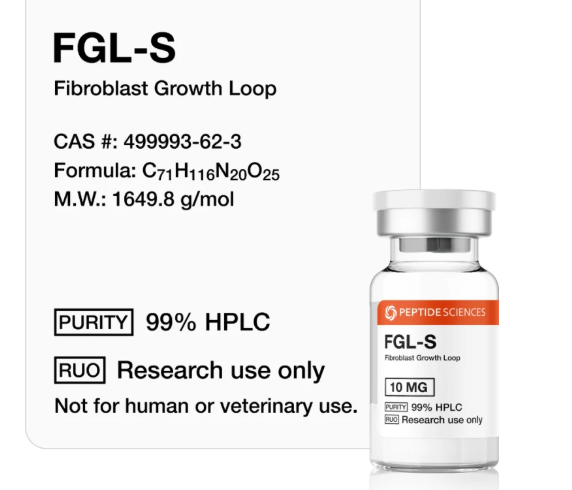
FGL-S is a synthetic peptide in the fibroblast growth loop (FGL) family and is derived from a sequence within the neural cell adhesion molecule (NCAM), also referred to as CD56. It is classified as an NCAM-mimetic peptide studied for its ability to engage fibroblast growth factor receptor signaling (commonly FGFR1) in experimental nervous system models. Research interest centers on how NCAM–FGFR interactions influence neurite development, synaptic architecture, and neuron–glia communication, which are core components of cellular neuroscience and plasticity research.
NCAM is expressed on neurons and glial cells and is involved in cell-to-cell adhesion and signaling processes that shape synaptic connectivity. Because FGFR-linked signaling networks regulate intracellular cascades associated with growth and structural remodeling, FGL-derived peptides are frequently used as tools to probe mechanistic relationships between receptor activation, synaptic organization, and measurable changes in neuronal morphology. Within the FGL series, FGL-S is described in the source text as a shorter-format variant used in research contexts where a smaller peptide analog is desired for experimental handling and synthesis considerations.
Biochemical Characteristics
Source: PubChem
Amino Acid Sequence: H-Glu-Val-Tyr-Val-Val-Ala-Glu-Asn-Gln-Gln-Gly-Lys-Ser-Lys-Ala-OH
Molecular Formula: C71H116N20O25
Molecular Weight: 1649.8 g/mol
PubChem CID: 16200289
CAS Number: 499993-62-3
Reported Synonyms: HY-P3281, DA-53184, CS-0655069
FGL-S has been described as a linear peptide whose primary structure reproduces a specific NCAM-associated motif. Structural descriptions are limited to compositional and physicochemical attributes reported in biochemical research sources.
Research Applications
FGL-S and related FGL peptides have been studied in in vitro neuronal cultures and in vivo animal models. In cell-based systems, researchers commonly quantify neurite outgrowth, dendritic spine density and morphology, synaptic marker changes, and receptor phosphorylation or downstream pathway activation relative to untreated controls. Mechanistic endpoints often include signaling readouts associated with FGFR engagement, such as MAPK-related and PI3K/Akt-associated pathway markers, along with measures of synaptic ultrastructure where applicable.
In animal studies, experimental designs frequently compare treated and control groups using endpoints such as performance on learning or memory tasks, sensorimotor measures, and histologic or molecular markers in relevant brain regions. Additional laboratory work has examined glial and inflammatory-associated measurements (e.g., changes in microglial activation markers) under induced inflammatory conditions, as well as transcriptional profiling in injury models. Across these study types, outcomes are reported as observed changes under laboratory conditions and interpreted within the limitations of the model system and the measured endpoints, without implying translation beyond preclinical research settings.
Pathway / Mechanistic Context
Mechanistic discussions in preclinical publications describe FGL peptides in relation to neural cell adhesion molecule (NCAM)–associated signaling and fibroblast growth factor receptor (FGFR)–linked intracellular pathways. These pathways have been examined in experimental systems for their involvement in cytoskeletal organization, vesicular dynamics, and transcriptional regulation.
Additional references describe observations involving kinase-associated signaling modules, including MAPK- and PI3K-related cascades, recorded under defined laboratory conditions. All pathway-related descriptions are limited to molecular and biochemical observations within experimental research settings.
Preclinical Research Summary
Preclinical studies cited in the scientific literature describe observations involving FGL peptides in cellular and non-clinical animal models. Reported observations include measurements of neurite-associated structures, synaptic ultrastructural features, gene expression markers, and signaling-associated proteins documented under defined experimental conditions.
Additional publications describe transcriptional and cellular responses observed following experimental injury or perturbation models. All reported findings remain restricted to the experimental systems employed and do not extend beyond laboratory research contexts.
Form & Analytical Testing
FGL-S is supplied as a research-grade synthetic peptide material. Identity and composition have been reported as characterized using analytical techniques commonly applied to peptide research materials, including chromatographic and mass spectrometric methods.
Handling, storage, and analytical verification parameters are determined by individual laboratories in accordance with internal research protocols.
Article Author
The above literature was researched, edited, and organized by Dr. Logan, M.D. Dr. Logan holds a doctorate degree from Case Western Reserve University School of Medicine and a B.S. in molecular biology.
Scientific Journal Author
Victor I. Popov, Ph.D. is a senior researcher at the Institute of Cell Biophysics, Russian Academy of Sciences, Pushchino, Russia. His published work focuses on synaptic transmission, presynaptic mechanisms, calcium signaling, and neuronal ultrastructure in experimental research systems.
Dr. Popov is cited solely for attribution of scientific authorship in the referenced literature. No endorsement, affiliation, or advocacy of any product is implied or stated. The purpose of citation is to acknowledge research contributions only.
Referenced Citations
V. I. Popov et al., “A cell adhesion molecule mimetic, FGL peptide, induces alterations in synapse and dendritic spine structure in the dentate gyrus of aged rats,” Eur J Neurosci, vol. 27, no. 2, pp. 301–314, Jan. 2008. doi: 10.1111/j.1460-9568.2007.06004.x.
A. Aonurm-Helm et al., “NCAM-mimetic, FGL peptide, restores disrupted FGFR signaling in NCAM-deficient mice,” Brain Res, vol. 1309, pp. 1–8, Jan. 2010.
T. Secher et al., “NCAM-derived FGL peptide and postnatal sensorimotor development,” Neuroscience, vol. 141, no. 3, pp. 1289–1299, 2006.
R. Anand et al., “Tolerability and pharmacokinetics of the FGLL peptide,” Clin Pharmacokinet, vol. 46, no. 4, pp. 351–358, 2007.
X. Wen et al., “Extracellular vesicles and synaptic toxicity models,” Int J Nanomedicine, vol. 20, pp. 4627–4644, 2025.
M. V. Pedersen et al., “NCAM-derived peptide modulation following traumatic brain injury,” Neurosci Lett, vol. 437, no. 2, pp. 148–153, 2008.
ALL ARTICLES AND PRODUCT INFORMATION PROVIDED ON THIS WEBSITE ARE FOR INFORMATIONAL AND EDUCATIONAL PURPOSES ONLY.
RUO Disclaimer
The products offered on this website are furnished for in-vitro studies only. In-vitro studies (Latin: in glass) are performed outside of the body. These products are not medicines or drugs and have not been approved by the FDA to prevent, treat, or cure any disease or condition. Bodily introduction of any kind into humans or animals is strictly forbidden by law.
For Laboratory Research Only. Not for human use, medical use, diagnostic use, or veterinary use.



Reviews
There are no reviews yet.