
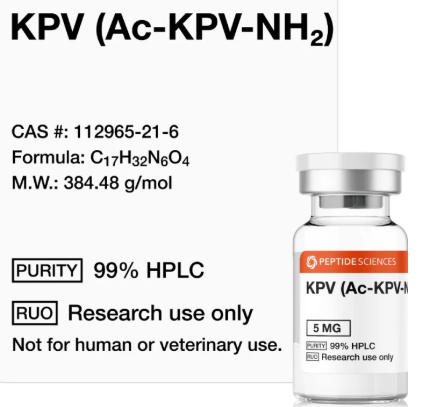
Ac-KPV-NH2 is an acetylated tripeptide (Lys–Pro–Val) corresponding to the C-terminal fragment of alpha-melanocyte-stimulating hormone (alpha-MSH). In laboratory research, this peptide is evaluated as a chemically defined tool compound for studying inflammatory signaling networks, epithelial transport biology, and downstream transcriptional regulation in cell-based systems and in vivo animal models.
Published work primarily characterizes Ac-KPV-NH2 using experimentally measured molecular, biochemical, and histological endpoints (e.g., cytokine-associated readouts, leukocyte migration indices, and pathway activity markers) under controlled preclinical conditions.
Biochemical Characteristics
Amino Acid Sequence: Lys-Pro-Val
Molecular Formula: C17H32N6O4
Molecular Weight: 384.48 g/mol
PubChem CID: 125672
CAS Number: 112965-21-6
Synonyms: MSH (11-13), ACTH(11-13), alpha-MSH(11-13)
Source: PubChem
Ac-KPV-NH2 is frequently used in experimental settings where compact peptide size supports mechanistic interrogation of peptide–cell interactions, including transporter-associated uptake in epithelial models and downstream pathway profiling using standard biochemical and transcriptional assays.
Research Applications
Ac-KPV-NH2 has been used in preclinical research workflows including:
• Experimental intestinal inflammation models to quantify cytokine-associated signaling and tissue inflammatory markers.
• Epithelial transport studies evaluating PepT1-mediated uptake and inflammation-linked transporter expression changes.
• Cell-based pathway assays measuring NF-kappaB and MAPK activity endpoints under inflammatory stimulation paradigms.
• Antimicrobial assay systems assessing peptide–microbe interactions and structure–activity relationships under controlled culture conditions.
• Matrix remodeling models examining collagen-related endpoints and cytokine-regulated fibroblast signaling markers.
Pathway / Mechanistic Context
Across preclinical systems, Ac-KPV-NH2 is discussed in relation to inflammatory mediator signaling and transcriptional control. Reported experimental readouts include changes in TNF-alpha–associated measurements and downstream pathway markers commonly used to contextualize NF-kappaB and mitogen-activated protein kinase activity in inflamed tissue paradigms.
A recurring mechanistic feature in gastrointestinal models is transporter-associated cellular entry via PepT1 (SLC15A1), which has been reported to be upregulated under inflammatory conditions in intestinal epithelium. This provides a framework for studying condition-dependent intracellular exposure and localized pathway modulation in experimental designs.
Source: PubChem
In published intestinal model figures, interpretation commonly relies on experimentally measured cytokine concentrations, immune cell infiltration indices, and histological scoring metrics as downstream endpoints used to infer pathway activity changes under controlled conditions.
Source: PubChem
Where differential effects are reported between inflamed and non-inflamed conditions, the discussion is typically framed as context-dependent differences in measured endpoints, consistent with transporter expression patterns and inflammatory-state biology in the specific model system.
Preclinical Research Summary
Intestinal Inflammation
In murine models of experimentally induced intestinal inflammation, Ac-KPV-NH2 exposure has been reported to be associated with measurable changes in inflammation-related endpoints, including inflammatory cell–associated histological markers, MPO activity measurements, and tissue morphology readouts, relative to control conditions. Reported group-level differences have also included changes in weight-associated parameters and other observational readouts used within the model design2.
Delivery strategies such as nanoparticle loading and hyaluronic acid functionalization have been used in animal studies to evaluate intestinal localization and compartmental exposure. These approaches are typically assessed using local cytokine concentration measurements (e.g., TNF-alpha–associated readouts) and mucosal tissue endpoints in the relevant experimental model3.
Inflammation-Associated Models
Additional preclinical paradigms (e.g., dermatitis models and immune activation settings) have evaluated alpha-MSH fragments using experimentally measured endpoints such as tissue swelling indices, leukocyte migration measures, and cytokine-associated readouts. Comparative discussions between alpha-MSH and shorter fragments commonly focus on differences in receptor engagement and downstream signaling signatures within the specific assay design.
Graph shows ear swelling due to contact dermatitis at 24 hours (left) and 2 weeks (right). Note that co-administration of Ac-KPV-NH2 with the irritant is nearly as effective as co-administration of alpha-MSH with the irritant at 24 hours. At 2 weeks, however, exposure to the stimulus without co-administration of the peptides shows much less swelling with alpha-MSH compared to Ac-KPV-NH2.
KPV (Ac-KPV-NH2): Matrix Remodeling / Collagen Pathways
In experimental wound repair and remodeling studies, alpha-MSH–related peptides are discussed in relation to cytokine-dependent fibroblast signaling and extracellular matrix markers. Reported molecular associations include IL-8–linked measurements and collagen-related pathway endpoints used to interpret remodeling-phase dynamics in preclinical systems.
Receptor Engagement Context
Reported receptor-blocking studies in animal models describe that certain inflammation-associated endpoints attributed to Ac-KPV-NH2 can remain detectable despite blockade of melanocortin receptors implicated in alpha-MSH signaling (e.g., MC3/MC4), supporting mechanistic discussion of receptor-independent or non-canonical signaling routes in specific experimental contexts.
Form & Analytical Testing
For research reagent workflows, Ac-KPV-NH2 is commonly characterized using standard analytical methods for synthetic peptides, such as chromatographic purity assessment (e.g., HPLC/UPLC) and mass-based identity confirmation (e.g., MS). Lot-specific analytical results are supplier- and batch-dependent and should be verified using the corresponding certificate of analysis (COA) when provided.
Article Author
The above literature was researched, edited and organized by Dr. E. Logan, M.D. Dr. E. Logan holds a doctorate degree from Case Western Reserve University School of Medicine and a B.S. in molecular biology.
Scientific Journal Author
Didier Merlin, Ph.D. is a professor at Georgia State University and research career scientist at Veterans Affairs Medical Center, Decatur, Ga. His research area is the study of intestinal epithelia, as directly related to intestinal bowel disease (IBD). Over one million adults and children in the U.S., including members of the VA population, suffer from IBD, and about 50,000 new cases are diagnosed each year. The VA IBD patients have a much higher rate of colorectal cancer compared to the general population. New therapeutic strategies based on a better understanding of the pathogenesis of IBD will improve the clinical care of veteran and non-veteran patients with this disorder.
Didier Merlin is being referenced as one of the leading scientists involved in the research and development of Ac-KPV-NH2. In no way is this doctor/scientist endorsing or advocating the purchase, sale, or use of this product for any reason. There is no affiliation or relationship, implied or otherwise, between Peptide Sciences and this doctor. The purpose of citing the doctor is to acknowledge, recognize, and credit the exhaustive research and development efforts conducted by the scientists studying this peptide. Didier Merlin is listed in 4 under the referenced citations.


Reviews
There are no reviews yet.